
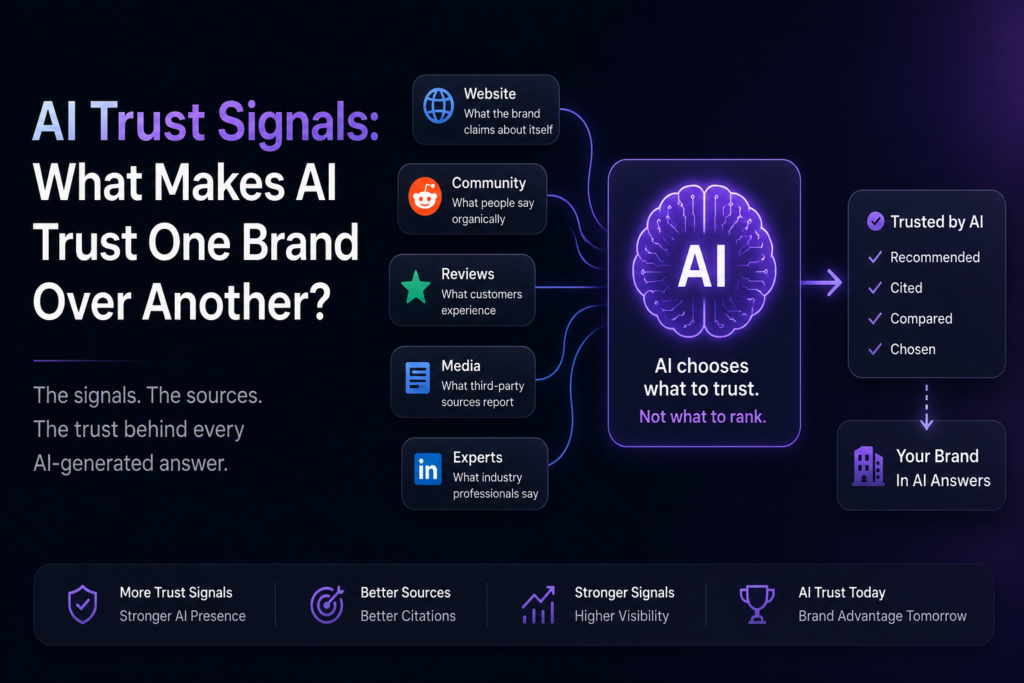
If you have spent any time checking how your brand shows up in ChatGPT or Perplexity, you may have noticed something strange. A brand that ranks on page one of Google is sometimes missing completely from AI answers. Meanwhile a smaller competitor with a weaker website keeps getting mentioned.
This is not a bug. It is a different system making a different kind of judgment.
Google mostly asks whether your page is relevant and well optimized. AI search engines are asking a harder question. Can this brand be trusted enough to recommend to someone without them checking further. That question is being answered using signals most SEO teams are not tracking at all.
In this article I am breaking down the framework we use at StackFree to explain and improve how AI systems trust a brand. It is built from a citation study covering more than 1100 prompts and 440 themes across ChatGPT, Perplexity, Gemini and Google AI Overviews, along with pattern analysis from real client work. Call it the AI Trust Stack.
Why Some Brands Rank on Google but Never Appear in LLM Tools?
This is usually the first thing founders notice, and it is often the most confusing part of AI visibility.
A brand can spend years building strong SEO. Good keywords, solid backlinks, clean site structure, consistent blog output. On Google, that work pays off with rankings. But when the same brand is searched inside ChatGPT or Perplexity, it is often nowhere to be found, while a smaller or newer competitor gets named instead.
The reason comes down to what each system is actually optimizing for.
Google is largely indexing and ranking your own content. If your pages are well built, Google rewards them, even if most of the proof of your quality lives only on your own site.
AI search engines work differently. Instead of just crawling your pages, they are trying to confirm whether the claims on your website are also true somewhere else. This is closer to how a person checks a brand before trusting it. You do not just read the company website, you look for outside confirmation.
In our research, this gap showed up clearly. Brands that ranked well on Google but had almost no presence outside their own website, no press mentions, no forum discussions, no comparison articles, were far less likely to be cited in AI answers than brands with a similar or even smaller SEO footprint but stronger third party visibility.
In other words, Google can be satisfied by your own website. AI search wants someone else to vouch for you first.
This is the core idea behind the framework in this article. Ranking is something you can control directly. Trust is something you have to earn across more places than just your own site.
What Are AI Trust Signals?
AI trust signals are the pieces of evidence an AI system uses to decide whether a brand is safe to mention or recommend. They come from your website, but also from reviews, community discussions, press mentions, and how consistently your brand is described across all of these places.
Think of them as the proof points AI is quietly checking before it puts your name in front of someone asking a question.
Why AI Search Needs More Proof Than Traditional SEO?
Traditional SEO was built around a simpler question. Is this page relevant and well structured for this search term. If yes, it earns a ranking.
AI search engines are answering a different question. If I recommend this brand to someone, will that recommendation hold up. That is a higher bar, and it changes what kind of content actually performs.
In our citation study, one pattern stood out clearly. Content that led with a direct, clear answer near the top of the page was retrieved by AI systems more often than content that opened with a long introduction or a story before getting to the point. But retrieval was only half the pattern. Depth is what determined whether a brand kept getting cited across different prompts and themes, not just pulled once.
This matters because most SEO content is still written to satisfy a keyword, not to satisfy a model that is trying to verify a claim. A page can be optimized well and still give an AI system nothing solid to stand behind.
This is why trust signals matter more in AI search than they ever did in traditional SEO. Google could reward a well built page on its own. AI search is looking for a page that holds up once it is checked against everything else being said about your brand elsewhere.
That checking process is exactly what the framework in this article is built to explain.
Introducing the AI Trust Stack
Every AI search or answer engine, whether it is ChatGPT, Perplexity, Gemini, Google AI Overviews, or Claude, is trying to solve the same basic problem before it recommends a brand. It needs enough independent proof that the brand is real, consistent, and safe to mention.
That proof does not come from one place. It is built up across seven layers, and the strength of a brand in AI search usually comes down to how solid each layer is, not just how good the website looks.
This is what we call the AI Trust Stack.
The 7 layers
- Website clarity and proof
- Entity and brand consistency
- Third party mentions
- Reviews and sentiment
- Community discussions
- Founder and expert authority
- Topical depth and ongoing visibility
Each layer answers a different question an AI system is quietly asking. Is this brand clearly described? Is that description consistent everywhere? Does anyone outside the brand confirm it? Do customers agree with what the brand claims? Is the brand talked about in unpaid, organic spaces. Is there a real person behind it? And has this been true for a while, not just in one recent push.
A brand can be strong in one or two layers and still struggle to show up in AI answers, because these engines are not looking for one good signal, they are looking for agreement across several.
The rest of this article breaks down each layer, what it means, why it matters to AI systems, what we observed in our research, and a real example of how it shows up.
The 7 Layers of the AI Trust Stack
AI does not decide to trust a brand because of one ranking factor or one great piece of content. Instead, it builds confidence by evaluating multiple signals across your website, your reputation, your expertise, and what other trusted sources say about you.
Together, these seven layers form what we call the AI Trust Stack.
1. Website Clarity and Proof
This is how clearly your website explains what you do, who you help, and what evidence supports your claims.
AI systems look for pages that answer questions directly. If a page is filled with vague marketing language or long introductions before explaining the main topic, there is very little for the model to extract and cite.
One of the most common mistakes is hiding the answer beneath paragraphs of brand storytelling. People may enjoy reading the story, but AI systems first need clear, factual information they can understand quickly.
During our analysis, pages that led with a direct answer before expanding on the topic appeared more consistently in AI generated responses than pages that delayed the answer.
For example, a service page that clearly explains what the service includes, who it is designed for, and the results customers can expect gives AI something concrete to reference. A page focused only on company values or mission statements provides much weaker evidence.
2. Entity and Brand Consistency
This is whether your brand is described consistently wherever it appears online.
AI systems try to confirm who you are before deciding whether to mention or recommend your business. Your company name, category, services, positioning, and expertise should tell the same story across every major platform.
A common problem is businesses describing themselves differently on their website, LinkedIn profile, business listings, and review platforms. Even small inconsistencies make it harder for AI systems to confidently understand the brand.
Brands that maintained a consistent identity across multiple trusted sources appeared more reliably than brands using different descriptions on every platform.
For example, if your website describes you as an AI visibility consultancy but your business directory lists you as a digital marketing agency, AI receives mixed signals about your expertise.
3. Third Party Mentions
This layer measures how often independent websites talk about your brand.
Unlike your own website, third party mentions are seen as external validation. They help AI understand that other people recognize your expertise, not just your own marketing team.
The strongest signals usually come from a combination of industry publications, comparison articles, business directories, interviews, resource pages, and trusted websites within your niche.
One isolated mention can help, but consistent mentions across multiple trusted sources create much stronger evidence. When independent websites describe your business in a similar way, AI becomes more confident that the information is reliable.
For example, a founder interview published on an industry website often carries more weight than another article published on the company’s own blog.
4. Reviews and Sentiment
This layer reflects what customers are saying about your business and whether those experiences support your brand’s claims.
AI looks beyond star ratings. It also evaluates the language people use when describing their experience.
If your website promises fast delivery, expert support, or excellent customer service, AI expects those same themes to appear naturally in customer reviews. When reviews consistently reinforce your messaging, they strengthen trust. When they tell a different story, they weaken it.
Businesses with reviews that matched their positioning appeared more consistently than businesses with strong websites but conflicting customer feedback.
For example, if your website promises rapid implementation but customer reviews repeatedly mention delays, AI has less reason to trust your original claim.
5. Community Discussions
This layer measures organic conversations about your brand on platforms where people are not being paid to talk about you.
Community discussions are valuable because they are difficult to manufacture at scale. They often represent genuine customer experiences rather than carefully written marketing content.
Across many industries, brands with active discussions on Reddit, forums, and niche communities appeared more frequently in AI answers than competitors with stronger SEO but almost no community presence.
For example, a handful of honest recommendations in a relevant Reddit community can sometimes provide stronger trust signals than another polished landing page because AI views those conversations as independent evidence.
6. Founder and Expert Authority
This layer measures whether real experts stand behind the information your brand publishes.
AI increasingly evaluates who is providing the information, not just what is being said. Visible expertise makes content more trustworthy.
Founder visibility goes beyond publishing articles. A named author, detailed author bio, LinkedIn profile, research, interviews, conference talks, and original insights all help AI connect expertise with the content being published.
Content supported by identifiable experts consistently performs better than anonymous content written without any clear authority.
For example, an original research article published under a founder’s name provides AI with a credible source to reference, while the same article published under a generic company account carries less authority.
7. Topical Depth and Ongoing Visibility
This layer measures how thoroughly your brand covers a topic over time.
AI looks for evidence of sustained expertise rather than isolated pieces of content. A single article may answer one question, but a connected collection of high quality resources demonstrates genuine authority.
Topical depth is built by publishing content that answers related questions, links naturally between articles, and continues to expand as the industry evolves.
During our analysis, brands with deep, interconnected content libraries appeared repeatedly across different prompts and topics, while brands relying on a few standalone pages were cited far less often.
For example, publishing one article about AI trust signals can generate visibility. Building a complete resource library covering AI trust, citation tracking, entity optimization, prompt research, and AI visibility creates much stronger long term trust signals.
Website Trust vs Community Trust vs Review Trust
Not all trust signals carry the same kind of proof. Here is how the three core types compare.
| Signal Type | What It Proves | Where It Lives | Example Platform |
|---|---|---|---|
| Website Trust | What the brand claims about itself | The brand’s own site | Homepage, service pages, about page |
| Community Trust | Whether people talk about the brand without being asked | Public, unpaid discussions | Reddit, forums, niche communities |
| Review Trust | Whether real customers agree with the brand’s claims | Verified customer feedback | Google reviews, G2, Trustpilot |
Website trust is necessary but not enough on its own, since it is entirely controlled by the brand. Community trust is the hardest to influence directly, which is exactly why AI systems weigh it so heavily. Review trust sits in between, it is customer generated, but it is still tied to a platform the brand can actively manage and improve.
A brand with strong website trust but weak community and review trust often looks solid to a person browsing manually, but weak to an AI system trying to confirm that the brand’s claims hold up outside its own site.
How to Audit Your AI Trust Signals?
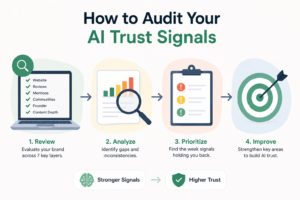
Most brands have never checked how they show up across these seven layers. They know their Google ranking. They rarely know whether ChatGPT, Perplexity, or Gemini would recommend them at all, or what is missing if it does not.
An AI trust audit looks at each layer of the stack individually. It checks whether your website states your value clearly, whether your brand is described consistently across platforms, how many third party mentions exist, what your reviews actually say compared to your website claims, whether you show up in any organic community discussions, whether a real person is attached to your brand’s authority, and how deep your topical coverage really goes.
The goal is not just to see where you stand today. It is to find the one or two layers holding back everything else, since AI systems are looking for agreement across the stack, not one strong signal.
This is the exact process we use at StackFree when running an AI visibility audit for a brand, mapped against all seven layers, with a clear picture of what is missing and what to fix first.
The AI Trust Signal Checklist
Use this checklist to check where your brand stands across the AI Trust Stack.
Website Clarity and Proof
- Homepage states clearly what you do and who it is for
- Key claims are backed by specifics, not just marketing language
- Service or product pages answer the question directly before explaining further
Entity and Brand Consistency
- Brand name and description match across your website, Google Business Profile, and LinkedIn
- Category or industry listed is the same everywhere you appear
- No conflicting descriptions across directories or profiles
Third Party Mentions
- At least a few mentions exist outside your own website
- Brand has been featured in press, roundups, or comparison articles
- Partner or guest content links back with accurate brand description
Reviews and Sentiment
- Reviews exist on at least one major platform
- Review language matches the claims made on your website
- No major unresolved negative pattern in recent reviews
Community Discussions
- Brand has been mentioned organically on Reddit or relevant forums
- Mentions are unpaid and not brand initiated
- No total absence from community spaces where your audience is active
Founder and Expert Authority
- A real person is publicly attached to the brand
- That person has published original insight, research, or a clear point of view
- Authority content is attributed by name, not just posted under the brand
Topical Depth and Ongoing Visibility
- Multiple pieces of content exist on your core topic, not just one
- Content pieces link to each other and build on the same subject
- Content has been published consistently over time, not in a single burst
A Note on How This Framework Was Built
This framework comes from a citation study covering more than 1100 prompts and 440 themes across ChatGPT, Perplexity, Gemini, and Google AI Overviews, combined with hands-on GEO and ORM work across client brands.
It reflects patterns we have observed consistently, not a fixed formula. AI recommendation systems are still evolving, and how heavily each layer is weighted may shift as these models change. What has stayed consistent so far is the underlying idea, AI systems trust brands that are confirmed across multiple places, not just brands that describe themselves well.
Final Takeaway
AI does not decide to trust a brand because of one great blog post, one backlink, or one five star review. It builds confidence by finding the same story repeated across many reliable sources.
That is why AI trust signals matter. Your website, customer reviews, community discussions, expert mentions, founder authority, and content all work together to help AI understand whether your brand deserves to be recommended.
The good news is that AI trust is not something you either have or do not have. It can be measured, improved, and strengthened over time. Every stronger trust signal increases the chance that your brand will be cited, compared, and recommended when people ask AI for advice.
As AI search becomes a bigger part of how people discover products and services, the brands that invest in trust today will have a clear advantage tomorrow. Building those signals now is no longer just a branding exercise. It is becoming an important part of long term search visibility.
FAQs
Why does my competitor show up in ChatGPT and I do not?
This usually comes down to third party mentions and community presence rather than website quality. A competitor with more outside confirmation, press mentions, reviews, or Reddit discussions, can outrank a brand with a stronger website but a thinner presence elsewhere.
Do I need to be active on Reddit for AI visibility?
You do not need to post constantly, but organic, unpaid mentions in relevant communities are one of the strongest trust signals AI systems rely on. A brand with a few genuine mentions often performs better than a brand with none at all.
Is a five star rating enough to be trusted by AI?
Not on its own. AI systems look at whether review language actually matches what your website claims, not just the star rating. A high rating with vague or unrelated reviews carries less weight than a slightly lower rating with reviews that confirm your specific claims.
How long does it take to build AI trust signals?
There is no fixed timeline, since it depends on how many layers need work. Third party mentions and community presence tend to take longer to build than fixing website clarity or brand consistency, which can often be corrected quickly.
Can a small brand appear in AI answers?
Yes. AI systems are not only weighing size or authority, they are weighing consistency and confirmation. A small brand with clear website claims, honest reviews, and a few genuine third party mentions can outperform a larger brand that is inconsistent across these layers.