
Who Should Read This Blog?
If you work in digital marketing, run a website, or are learning SEO, this blog is for you.
Search has changed a lot in 2024 and 2026. If you are still following old SEO methods, your traffic may already be dropping. This guide will help you understand what has changed, what GEO means, and what you actually need to do differently right now.
Introduction: SEO Has Changed. Have You?
Many people still think SEO is only about keywords, backlinks, and writing long blogs to rank on Google.
That approach used to work. But today, it is no longer enough.
According to Search Engine Land, Google AI Overviews now appear in over 47% of search results as of 2025. Users are reading AI-generated summaries instead of clicking on links. This means the old goal of ranking number one to get clicks is no longer the full picture.
The real question today is not just: can your page rank? It is: can your content be trusted and used as an answer by AI systems?
This is where GEO, Generative Engine Optimization, comes in.
In this blog, we will cover:
Why old SEO methods are losing power Why keyword-only SEO no longer works How AI has changed the way search engines think What GEO is and how it works How to structure content for both humans and AI What E-E-A-T means and why it matters more now What skills modern SEO professionals actually need The future of SEO and what you should do next
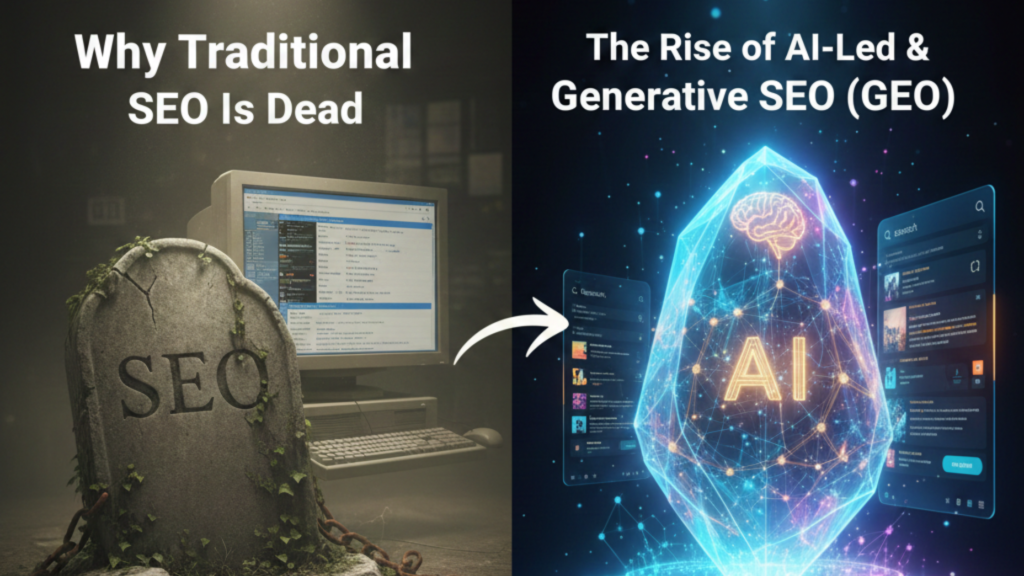
Is Traditional SEO Really Dead?
No. Traditional SEO is not fully dead. But old-style SEO that only focuses on keywords is not reliable anymore.
Traditional SEO used to work like this:
Step 1: Pick a keyword
Step 2: Write 1,000 words Step 3: Repeat the keyword many times Step 4: Build a few links Step 5: Wait for rankings
This still works sometimes. But it is no longer a dependable strategy.
Why? Because search engines now try to give the best answer, not the page with the most keyword matches. They ask:
Does this page actually solve the user’s problem? Is the content written clearly? Does it come from a trustworthy source? Does it match what users really want?
If your content is vague, copied, or written just to fill word count, it gets skipped, even if the keywords are there.
What SEO cares about now:
Search intent, meaning what the user actually wants Topic depth, meaning does the page cover the full idea Clarity, meaning can someone understand it quickly Proof of experience, meaning does it show real knowledge
Only shallow SEO is dying. SEO built on real understanding is stronger than ever.
Why Keyword-Only SEO No Longer Works
Keyword-only SEO no longer works because search engines now understand meaning and intent, not just exact words.
Earlier, if someone searched for best SEO course, pages that repeated this phrase many times ranked higher. Today, that logic is outdated.
Search engines now ask smarter questions:
Does this page fully answer what the user needs? Is the content genuinely helpful or just keyword-stuffed? Does it match what users typically expect for this search?
If the answer is no, rankings drop, even if all the keywords are present.
How search engines think today:
Context: What does the full sentence mean? Intent: Why did the user search for this? Relevance: How closely does the content match the real need?
Example: When someone searches for AI SEO strategy 2026, they are not looking for a definition of SEO or a random tools list. They want to know how SEO is changing, how AI fits into it, and what steps matter now. A page that only repeats the keyword without answering these questions will fail.
Keywords are still useful but their role has changed. Today, keywords help search engines understand the topic, not decide rankings on their own.
What matters more:
Topic coverage Clear explanations Related ideas explained simply Logical structure from start to finish
How AI Has Changed the Way Search Engines Work
AI has changed search engines from keyword matchers into problem-solving systems.
Earlier, search engines mainly checked two things: keywords on a page and links pointing to it. Now, AI systems help search engines understand what the user is really asking, which content explains the topic clearly, and which sources look reliable and experienced.
From matching words to understanding meaning
Modern search engines use large language models that can read and understand text almost like humans do. They do not just scan for matching words. They try to understand:
The full topic of the page How ideas connect with each other Whether the content genuinely answers the question
Why Google AI Overviews exist
Google AI Overviews exist because users want fast, clear answers. According to BrightEdge research, AI Overviews were visible in nearly half of all Google searches by mid-2025.
To create these summaries, AI systems look for content that:
Answers questions directly and early Is easy to understand Is well structured with clear headings Comes from a focused and credible source
Content written only for rankings often fails here. Content written to genuinely help the reader performs much better.
Why AI makes it harder to fake expertise
Shallow content, copied blogs, and generic advice are now easy for AI to detect. Pages that show real understanding, clear thinking, and practical experience are far more likely to be trusted, cited, and reused by AI tools.
What Is Generative Engine Optimization (GEO)?
Generative Engine Optimization, or GEO, is the process of creating and structuring content so that AI systems can clearly understand it, trust it, and use it when generating answers.
GEO is not about ranking alone. It is about being selected, summarized, and referenced by AI-driven search tools.
Why GEO exists
Search is no longer limited to blue links. Today, users get answers from:
Google AI Overviews ChatGPT Search Gemini Perplexity Microsoft Copilot
These systems do not show results the same way as traditional search engines. They read multiple sources, understand patterns, and generate a single summarized answer. If your content is unclear, poorly structured, or full of filler, AI systems skip it.
How GEO works in simple terms
Instead of asking how can I rank this page, GEO asks: how can this page become a trusted answer?
That means your content must:
Clearly answer the question near the top Explain ideas in simple, precise language Follow a clean and logical structure Show real understanding of the topic through examples and specifics
GEO vs Traditional SEO
Traditional SEO main goal: Rankings and traffic GEO main goal: Being used as an answer
Traditional SEO focuses on: Keywords and links GEO focuses on: Clarity and trust
Traditional SEO success metric: Impressions and clicks GEO success metric: AI citations and authority
Traditional SEO approach: Optimize the page GEO approach: Optimize the thinking
Traditional SEO brings users to your content. GEO brings your content to the user through AI.
How to Structure Content for AI and Human Readers
Good structure directly affects how AI tools read, select, and reuse your content. Here is how to do it right.
-
Start with a clear, direct answer
Each section should begin with a short answer to the question the heading asks. This helps AI tools pick the right information and helps readers understand the point without scrolling.
-
Use WH-family headings
Your headings should ask or answer real questions starting with What, Why, How, Who, and When. These match how people actually search, and they are the format Google most often pulls into featured snippets and AI Overviews.
-
Keep paragraphs short
Long blocks of text are hard to read and hard for AI to process. Keep paragraphs to 2 to 4 lines. Explain one idea at a time. Move step by step.
-
Write for understanding, not length
More words do not mean better content. AI systems prefer content that explains ideas clearly and avoids filler. If a sentence does not add value, remove it.
-
Use examples and specifics
Vague writing loses trust. Specific examples, even simple ones, show that you understand the topic from real experience, not just theory.
What Is E-E-A-T and Why Does It Matter for SEO in 2026?
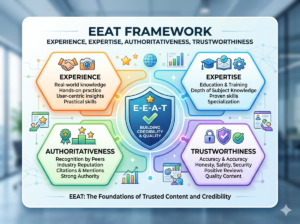
E-E-A-T matters more than ever because AI systems prefer content that shows real experience, clear expertise, and honest trustworthiness.
E-E-A-T stands for:
Experience: Have you actually done this work? Expertise: Do you understand the topic deeply? Authoritativeness: Are you focused and consistent on this subject area? Trustworthiness: Is the content accurate, honest, and verifiable?
How AI checks for E-E-A-T
AI tools look for signals like:
Clear explanations that show real understanding Logical flow and accurate use of terms Specific examples from practice, not just theory Consistent focus on one subject area Links to trusted external sources
You do not need to say I am an expert. Your explanations should prove it naturally.
Why shallow content fails E-E-A-T
Many blogs fail because they repeat what others say, avoid taking clear positions, and stay at surface level. AI systems are good at spotting this. They prefer a few strong, specific sources over many weak and generic ones.
Practical tip: Add a short author bio below your blog title. Include your experience, your area of focus, and a link to your LinkedIn or portfolio. This single step significantly improves how search engines evaluate your content’s trustworthiness.
What Skills Do Modern SEO Professionals Actually Need?
Modern SEO professionals need strategy, data understanding, and systems thinking, not just tools or checklists.
SEO roles today sit between marketing, data, and technology. Companies expect SEO professionals to understand how traffic turns into real business results.
Core skills that matter in real SEO roles today:
GEO and AI-led SEO: Structuring content so AI tools can understand, trust, and cite it Search intent mapping: Understanding what users want at every stage, not just what they type Content strategy with conversion focus: Guiding users through funnels, not just attracting traffic Data analysis: Using GA4, Google Search Console, and Looker Studio to make decisions E-E-A-T building: Establishing authority through consistent, expert-level content AI tools and prompt use: Working with ChatGPT, Claude, and Perplexity effectively CRO basics: Understanding what happens after users land on a page
Why these skills are hard to get from basic courses
Most courses teach tools in isolation. Real SEO work requires connecting skills together, building traffic systems, content systems, and data systems that work as one. That is the difference between someone who knows SEO and someone who can actually grow a business through search.
Check
When Should You Switch to a GEO-First Strategy?
The right time to shift to a GEO-first approach is now, especially if:
Your organic click-through rate has dropped despite stable rankings AI Overviews are appearing for your target keywords Your content is getting impressions but not conversions You are in a topic area where trust and expertise matter, such as education, finance, health, or tech
If you are starting a new website or content strategy, build GEO principles in from day one. It is much easier than retrofitting old keyword-heavy content later.
The Future of SEO Is Strategic, Not Tactical
The future of SEO depends on strategy, clear thinking, and sound decision-making, not on repeating fixed steps or checklists.
Tactics still matter. Adding keywords, publishing content, and building links all have a role. But they only work when guided by the right strategy. Without strategy, effort is wasted and results are unpredictable.
Strategic SEO focuses on questions like:
Which topics are genuinely worth investing in? Which pages drive real value for our audience? What should be improved first for the biggest impact? How can AI support and speed up this work?
Answering these questions requires judgment, and judgment cannot come from tools alone.
Where AI fits in the future of SEO
AI will continue to help with research, content creation, and data analysis. But humans will still lead strategy. The strongest SEO professionals will guide AI with clear intent, review outputs critically, and connect insights to real business outcomes.
AI becomes a support system, not a replacement for thinking.
Frequently Asked Questions
What is the difference between SEO and GEO?
Traditional SEO focuses on ranking pages for keywords in search results. GEO focuses on making your content clear and trustworthy enough that AI tools like Google AI Overviews, ChatGPT, and Perplexity select it as a source when generating answers.
Is traditional SEO still worth doing in 2026?
Yes. Traditional SEO practices like technical optimization, internal linking, and building topical authority are still important. The difference is that keyword stuffing and low-quality content no longer work. You need to combine classic SEO with GEO principles to stay competitive.
How do I optimize content for Google AI Overviews?
Start your sections with direct answers to the question in the heading. Use clear, simple language. Structure your content with WH-family headings covering what, why, how, who, and when. Include specific examples and cite credible sources. Avoid filler and vague writing.
What does E-E-A-T mean in SEO?
E-E-A-T stands for Experience, Expertise, Authoritativeness, and Trustworthiness. Google uses these signals to evaluate whether content comes from someone with real knowledge. To improve E-E-A-T, add an author bio, use specific examples, link to credible sources, and stay focused on your core topic area.
How long does it take to see results from a GEO strategy?
GEO-focused improvements to content structure and clarity can start showing results in 4 to 12 weeks, depending on your site’s authority. Being cited in AI Overviews often happens faster than traditional ranking improvements, because AI tools prioritize clarity and trustworthiness over domain age.
Who needs a GEO strategy?
Any business or individual that depends on search traffic. GEO is especially important for educators, coaches, niche experts, SaaS companies, and content publishers, meaning anyone whose audience uses AI tools to research before buying or learning.
Conclusion: SEO Is Moving from Tasks to Thinking
Traditional SEO is not disappearing. But the rules have changed deeply.
Search engines and AI tools now focus on meaning, intent, clarity, and trust. Pages written only for keywords are losing visibility. Pages written to genuinely solve problems are being selected, cited, and trusted by both humans and AI systems.
The GEO and AI SEO strategy shift is not a trend. It is the new foundation of how search works.
The future belongs to professionals and brands who: – Understand how search engines and AI tools think Use data to guide decisions, not just instinct Build content that shows real expertise and experience Structure everything so both humans and AI can understand it fast
Start with one article. Audit it against the principles in this guide. Fix the structure, add real examples, write for clarity, and define your focus keyphrase. That single article, done right, can outperform ten keyword-stuffed pages.
SEO is no longer a checklist task. It is a strategic skill. And those who learn it deeply will stay relevant as search continues to evolve.
Pingback: AI Trust Signals: What Makes AI Trust One Brand Over Another? -