
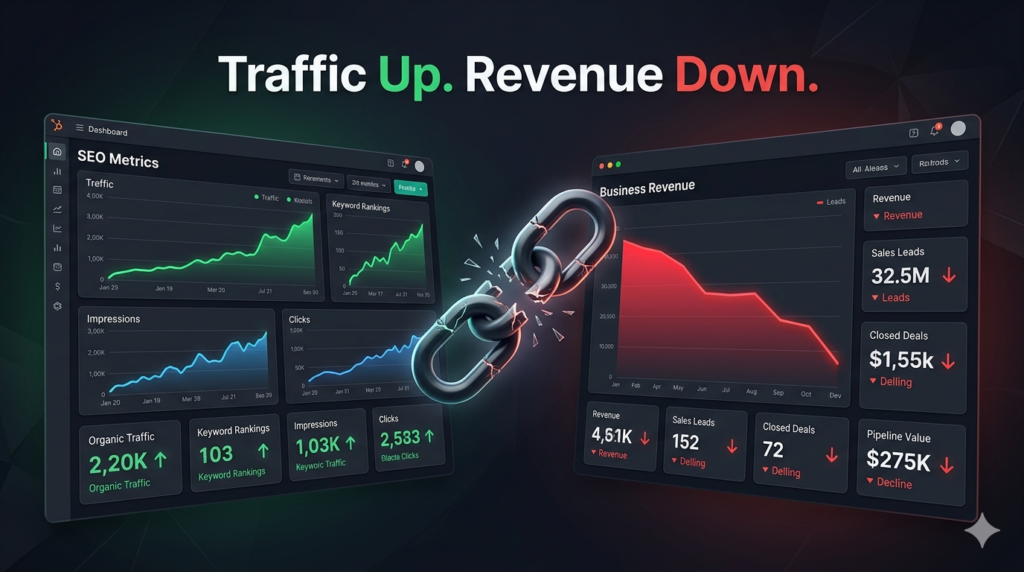
You open your analytics dashboard. Organic traffic is up. Rankings are climbing. Impressions are growing every month.
So why is your phone not ringing?
Why are leads still flat? Why has revenue not moved?
This is one of the most frustrating situations a business owner can face. You are paying an SEO agency. The numbers look good on paper. But nothing changes in your business.
The truth is hard to hear — but it is important.
Most SEO agencies are optimising for traffic. Not for your revenue.
And those are two very different goals.
In this post, we break down exactly why SEO agencies fail to generate revenue, what they get wrong, and what a proper revenue-focused SEO strategy actually looks like.
What Most SEO Agencies Actually Focus On
Before we talk about what goes wrong, it helps to understand what most agencies actually spend their time on.
Keyword Rankings
Most SEO agencies send you a monthly report showing how many keywords moved up or down. Position 14 is now position 7. Position 3 held steady. A new keyword entered the top 10.
This feels like progress. But rankings alone do not pay your bills.
Organic Traffic Growth
Sessions, users, clicks — these are the metrics most agencies live and die by. A 30% traffic increase looks great in a slide deck. But if that traffic is not converting, the number means nothing for your business.
Technical SEO Fixes
Core Web Vitals. Redirects. Sitemap issues. Indexing errors. These things matter — they are the foundation. But fixing technical issues alone will never generate leads.
Publishing More Blog Content
Content calendars. Publishing targets. Word counts. Most agencies focus on output, not outcomes. More blogs do not automatically mean more customers.
Link Building Campaigns
Backlinks and domain authority are real ranking factors. But they are inputs, not outputs. Links help pages rank. Ranked pages only help you if they convert visitors into leads.
Here is the problem: most SEO agencies stop here. They deliver on traffic metrics and call it a success. Meanwhile, your revenue stays exactly where it was.
The Biggest SEO Mistake: Traffic Without a Conversion Strategy
This is where most SEO efforts completely fall apart.
More Visitors Does Not Mean More Customers
Let us look at a simple example.
Website A: 20,000 visitors per month, 10 leads || Website B: 5,000 visitors per month, 80 leads
Website B is getting a quarter of the traffic. But it is generating 8x more leads.
Which business would you rather run?
Traffic volume is a vanity metric if your website does not convert. Getting more people to visit a broken experience just means more people leaving without buying.
Why SEO Without CRO Fails
SEO without CRO (Conversion Rate Optimisation) is one of the most common and costly mistakes in digital marketing.
You can rank on page one for your best keyword. But if a visitor lands on your page and faces any of these issues, they will leave:
- Weak or confusing call-to-action
- A contact form that is too long or too complicated
- Navigation that is hard to follow
- No trust signals like reviews, certifications, or client logos
- A poor mobile experience
- Slow page load speed
Every one of these issues leaks leads. And most SEO agencies do not look at any of them.
What Happens When You Improve Conversion Rate
Here is the exciting part about fixing CRO. It multiplies the results you are already getting from SEO.
Say your site currently converts 1% of visitors. You fix the landing page, simplify the form, and add social proof. Now it converts 3%.
You just tripled your leads without getting a single extra visitor.
That is the power of combining SEO with CRO. Traffic brings people in. CRO turns them into customers.
Why SEO Without Tracking Creates Blind Spots
If you cannot see what is working, you cannot improve it. Yet most businesses have serious gaps in their tracking setup.
Most Businesses Cannot See Which Pages Generate Leads
Here is what happens without proper SEO tracking:
- Traffic goes up. Great.
- But you do not know which pages are sending leads.
- You do not know which keywords are converting.
- You do not know if your blog is helping or just eating your content budget.
Without GA4 configured correctly, without event tracking in place, and without proper attribution, you are flying blind.
Common Tracking Problems We See
These are the issues we find on almost every new client audit:
- Form submissions not tracked as conversions
- No call tracking phone leads are invisible
- CRM not connected to analytics
- Wrong goals set up in GA4
- Assisted conversions completely ignored
Every one of these gaps means you are making decisions based on incomplete data. You might be cutting a campaign that is actually working. Or you might be doubling down on content that has never generated a single lead.
You Cannot Improve What You Cannot Measure
This is not a cliche. It is the foundation of any SEO strategy that actually moves revenue.
Fix your tracking first. Then optimise. In that order.
Why Content Alone Does Not Drive Business Growth
Content is not the problem. Random content with no strategy is the problem.
Publishing More Blogs Is Not a Strategy
Many SEO agencies sell content volume. More blogs per month means more traffic opportunities. That logic is not entirely wrong but it is dangerously incomplete.
Without a clear content strategy, most blogs are written for topics with no buyer intent. They bring in readers who will never become customers.
High Traffic Keywords Often Bring Low Revenue
Not all keywords are equal. Consider the difference between these two searches:
- “what is CRM software” → informational, likely in research mode
- “best CRM software for small business” → commercial, much closer to buying
Many SEO agencies chase the first type because the traffic numbers are bigger. But the second type drives revenue. A smaller number of commercial-intent visitors is almost always worth more than a large number of informational visitors.
Content Should Support the Entire Buyer Journey
A good content strategy covers every stage of how a buyer moves toward a decision.
Awareness Content This is for people who just discovered they have a problem. They are searching for answers, not solutions yet. Blog posts, guides, and explainers belong here.
Consideration Content This is for people comparing options. Case studies, comparisons, “best of” guides, and tool breakdowns work well here.
Decision Content This is for people ready to act. Service pages, pricing pages, testimonials, and demo request pages live here.
Most agencies write only awareness content. Decision content the pages that actually close customers gets ignored. That is a direct cause of why SEO traffic does not convert into revenue.
Why Online Reputation Management Matters for SEO
Most SEO agencies focus on what happens on your website. But your buyers are researching you far beyond your website.
Buyers Search More Than Your Website
Before anyone fills out your contact form, they search for you. They check:
- Google reviews
- Trustpilot or G2 ratings
- Your founder’s LinkedIn profile
- Reddit threads mentioning your company
- Third-party review sites in your industry
Online reputation management (ORM) is the practice of shaping what buyers find when they search for your brand.
If this search returns negative reviews, unanswered complaints, or nothing at all you will lose leads that your SEO worked hard to bring in.
Negative Brand Signals Reduce Conversions
Here is a scenario that happens every day.
A buyer clicks your organic result. They like what they see. Before filling the form, they quickly Google your brand name. They find a one-star review with no response, or a Reddit thread with complaints.
They close the tab.
Your SEO did its job. Your ORM failed. The lead is gone.
SEO Traffic Cannot Fix Trust Problems
This is an important point that almost every SEO agency misses. If your brand has a trust problem, more traffic will not fix it. It will just bring more people to an experience that turns them away.
ORM is not optional for a business that wants SEO to drive revenue. It is part of the system.
Why Landing Page Optimisation Is Part of SEO
Landing page optimisation is not separate from SEO. It is the last mile of SEO and the most important one.
Your Service Pages Matter More Than Your Blog Posts
Most agencies spend most of their time on blog content. But for lead generation, the pages that matter most are:
- Service pages
- Category pages
- Location pages
- “Money pages” the pages where buyers make decisions
These are the pages where your SEO investment either pays off or gets wasted.
Common Landing Page Problems
When we audit landing pages for businesses that have traffic but no leads, we almost always find the same issues:
- The headline is weak or too vague
- The call-to-action is buried below the fold
- There is no social proof no reviews, no case studies, no numbers
- The contact form is too long
- The page structure makes it hard to scan
- There is no clear answer to “why should I choose you?”
Every one of these problems costs you leads. And most of them are fixable without changing your SEO strategy at all.
Every SEO Visit Should Have a Clear Next Step
When a visitor lands on any page of your site, they should always know what to do next. The next step should be obvious, easy, and relevant to where they are in their journey.
If a visitor has to think for more than a few seconds about what to do next they will leave.
Why Modern SEO Needs AI Automation
SEO is getting more complex every year. The volume of data, the number of variables, and the speed of change have all increased. Manual SEO is simply not fast enough anymore.
Manual SEO Is Becoming Slower Every Year
Think about everything that goes into a proper SEO operation:
- Technical audits across hundreds of pages
- Internal linking across a large site
- Content gap analysis against competitors
- Entity extraction for topical authority
- Monthly reporting across multiple tools
Doing all of this manually takes weeks. By the time you act on the data, things have changed.
How AI Supports Better SEO Operations
AI automation in SEO is not about replacing strategy. It is about removing the slow, repetitive work so your strategy can move faster.
Here is where AI adds real value:
- Faster research and keyword clustering
- Automated content briefs based on competitor analysis
- Entity and topic extraction for better content coverage
- Reporting dashboards that update automatically
- Internal linking suggestions at scale
This is not about using ChatGPT to write generic blogs. It is about building smarter systems that let you act on data faster than your competitors.
What Businesses Should Look for Instead of a Traditional SEO Agency
If you are evaluating SEO agencies or wondering whether your current one is the right fit here are the questions you should be asking.
Look for revenue growth, not traffic growth. Any agency you work with should be able to show you how their work connects to leads, sales, and revenue — not just sessions and rankings.
Ask how they measure leads. How do they track whether SEO is generating enquiries? Do they set up conversion tracking? Do they connect GA4 to your CRM?
Ask about CRO. Do they look at your landing pages? Do they run tests? Do they care about what happens after someone lands on your site?
Ask about tracking setup. Will they configure GA4 events properly? Will they set up call tracking? Can they show you which pages generate leads?
Ask about content strategy. Are they writing for buyer intent, or just traffic? Do they map content to different stages of the buyer journey?
Ask about landing page optimisation. Do they review and improve your service pages, or only your blog?
Ask about ORM. Do they monitor what buyers find when they search for your brand?
Ask about automation. Are they using AI and automation to move faster and deliver more value?
If an agency cannot answer most of these questions, they are offering you a traditional traffic-focused SEO service — not a revenue SEO service.
The Revenue SEO Framework
At GrowthOS, we use an 8-step framework that connects SEO directly to revenue. Most agencies stop at step two.
Step 1: Technical SEO
Fix the foundation. Crawlability, site speed, indexing, redirects, mobile usability. Without this, nothing else works properly.
Step 2: Content Strategy
Create content that matches buyer intent at every stage of the journey. Awareness, consideration, and decision content — all mapped to the right keywords.
Step 3: Conversion Rate Optimisation
Improve the pages that get traffic. Better CTAs, clearer messaging, stronger social proof, and simpler forms.
Step 4: Tracking and Analytics
Set up proper GA4 event tracking, conversion goals, call tracking, and CRM integration. Know exactly which SEO activity is generating leads.
Step 5: Landing Page Optimisation
Improve service pages, category pages, and money pages so every organic visit has the best possible chance of converting.
Step 6: Online Reputation Management
Monitor and improve what buyers find when they search for your brand outside your website.
Step 7: AI Automation
Use AI tools to speed up audits, content operations, internal linking, and reporting so your team can focus on strategy.
Step 8: Revenue Reporting
Report on what actually matters leads generated, cost per lead, revenue influenced by SEO not just traffic and rankings.
Why Most SEO Agencies Stop at Step 2
Traditional SEO agencies focus on technical fixes and content publishing. Those are steps 1 and 2 of this framework. They are necessary — but they are not enough.
Revenue SEO requires all 8 steps working together. When they do, SEO becomes one of the highest-ROI channels in your marketing mix.
Final Thoughts
SEO should generate revenue, not just traffic.
If your SEO strategy only includes technical fixes and blog publishing, you are leaving most of the value on the table. The businesses that win with SEO combine multiple disciplines into one connected system:
- SEO brings the right visitors to your site
- CRO turns those visitors into leads
- Tracking shows you exactly what is working
- Content strategy covers the full buyer journey
- Landing page optimisation makes every visit count
- ORM builds the trust buyers need before they contact you
- AI automation keeps the whole system moving fast
- Revenue reporting keeps everyone accountable to business outcomes
When all of these work together, SEO stops being a cost centre and becomes a revenue engine.
If you want to build that kind of system for your business, that is exactly what we do at OUR Agency
Your SEO Problem May Not Be SEO
Getting traffic is only part of the equation. Many businesses lose leads because of weak conversion paths, poor tracking, ineffective landing pages, or gaps in their content strategy. Book a free consultation to identify what’s limiting your lead generation and where the biggest growth opportunities exist.
Frequently Asked Questions
Why do SEO agencies fail to generate revenue?
Most SEO agencies focus on traffic and ranking metrics rather than business outcomes. They deliver sessions and keyword positions but do not optimise for conversions, lead tracking, or landing page performance. Without these pieces, traffic growth rarely translates into revenue.
Can SEO increase revenue?
Yes but only when it is connected to the right strategy. SEO needs to work alongside CRO, proper tracking, strong landing pages, and content that matches buyer intent. Traffic alone does not generate revenue. A system that converts traffic into leads and customers does.
Why does my website get traffic but no leads?
This is almost always a combination of issues weak landing pages, missing conversion tracking, no clear call-to-action, or traffic that does not match buyer intent. Getting more traffic will not fix this. You need to look at what happens after someone lands on your site.
Is CRO important for SEO?
Absolutely. SEO without CRO is one of the most common reasons businesses see traffic growth with no lead growth. CRO improves the percentage of visitors who take action on your site. When you combine good SEO traffic with a well-optimised site, results multiply.
What is Revenue SEO?
Revenue SEO is a strategic approach that connects SEO activities directly to business outcomes leads, sales, and ROI. It goes beyond traffic and rankings to include CRO, tracking, landing page optimisation, ORM, content strategy, and AI automation. The goal is measurable revenue growth, not just organic traffic growth.
How do I measure SEO ROI?
To measure SEO ROI properly, you need conversion tracking set up in GA4, goal completions tied to actual lead events, and ideally a connection between your analytics and CRM. From there, you can calculate cost per lead from SEO and compare it against revenue generated from those leads.
What should an SEO agency track?
A good SEO agency should track keyword rankings, organic traffic, and technical health but also form submissions, call conversions, lead quality, assisted conversions, and revenue influenced by organic search. If your agency only reports on traffic and rankings, you are not getting the full picture.
Why is tracking important for SEO?
Without accurate tracking, you cannot tell which pages generate leads, which keywords bring buyers, or whether your SEO investment is actually working. Tracking turns SEO from a guessing game into a data-driven system you can optimise over time.
Pingback: How I Built an AI Workflow That Generates a Full SEO and GEO Strategy in 3 Minutes
Pingback: The Real Reason Your Recruitment Website Is Not Bringing In Client Leads -